What laboratories should do when QC goes out of control
When QC becomes unacceptable, laboratories must contain, investigate, correct, verify, assess patient impact, and authorise return to routine work. A failed QC does not automatically mean every patient result is wrong—it signals that the analytical system requires documented review and evidence of recovery. A LIMS can support traceability, alerts, corrective-action records, result review, and audit history, while professional judgement remains essential for investigation and patient-result decisions.
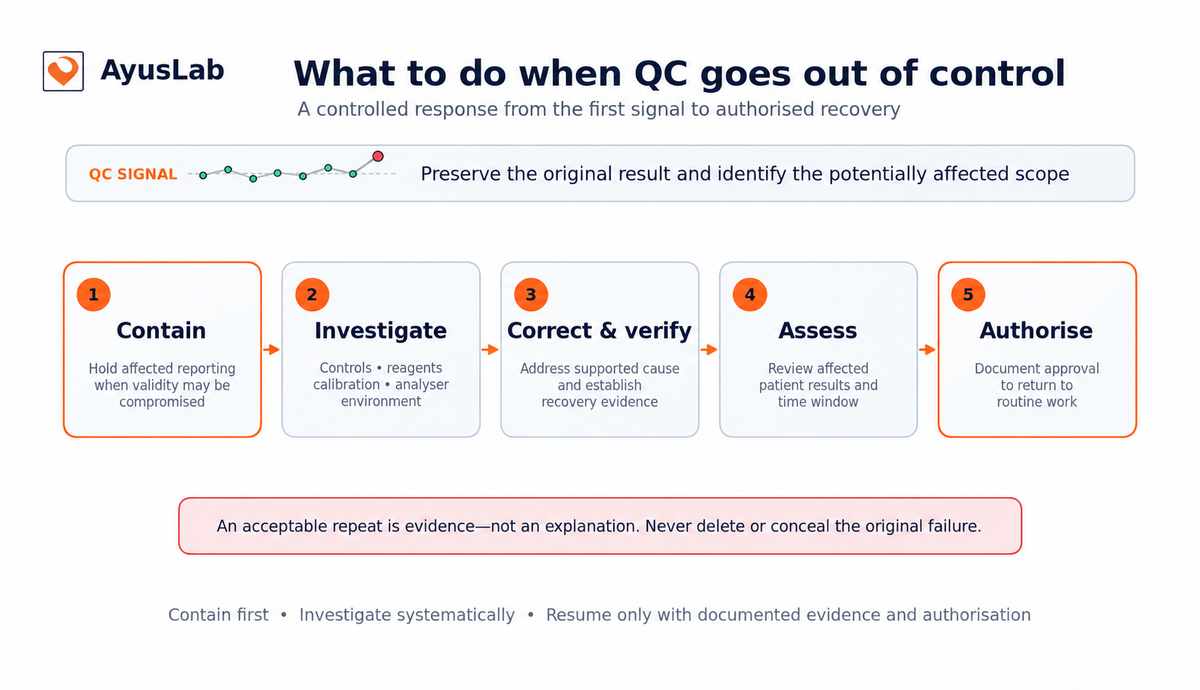
When internal quality control becomes unacceptable, the laboratory needs more than a quick repeat. It needs a controlled response that protects potentially affected reporting, investigates the analytical system, establishes evidence of recovery and considers whether patient results require action.
An out-of-control signal does not automatically mean that every patient result is wrong. It means the examination system has breached the laboratory's approved acceptance criteria or produced a pattern that requires review. The response should be proportionate to the possible error and documented from the first signal to the authorised return to routine work.
In brief: contain, investigate, correct, verify, assess and authorise.
1. What out of control means
QC may be considered unacceptable when a result breaches a rejection limit, a sequence violates an approved statistical rule or another defined acceptance criterion is not met. The signal may suggest random error, systematic change or a problem unrelated to the analyser itself.
Examples include an isolated extreme control result, a sudden shift, a progressive trend, excessive difference between control levels, or a control failure associated with an instrument flag. The laboratory's procedure must define which observations are warnings and which require rejection or containment.
The QC chart or rule identifies a signal; it does not diagnose the cause. A single failure should not lead automatically to recalibration, maintenance or repeated control testing. Investigation should follow the evidence.
2. Immediate containment
First identify what may be affected: the analyser or method, analyte, control level, analytical run and time period. If the validity of patient results may be compromised, hold or stop release of the relevant results according to the approved procedure.
Containment should be specific. A failure affecting one analyte may not require stopping unrelated examinations if the laboratory can demonstrate that they are independent and acceptable. Conversely, a common instrument, reagent, calibration or environmental failure may affect several analytes.
Record the original control result, instrument messages, time and operator before changing anything. Do not delete the failed result or replace it with a later acceptable repeat.
Urgent work requires a defined contingency. This may involve another verified analyser or method, referral to an authorised laboratory, or a documented decision by the responsible professional. Urgency is not evidence that an uncontrolled system is suitable for reporting.
3. Checking control material, reagent and calibration
Begin with the most direct and plausible causes while preserving traceability.
For the control material, check:
- correct control, level and lot;
- expiry and open-vial or reconstituted stability;
- preparation, mixing, storage and thawing conditions;
- contamination, evaporation or insufficient volume; and
- whether other levels or analytes show the same pattern.
For reagents and consumables, review lot identity, expiry, onboard stability, storage conditions, remaining volume, preparation and recent replacement. Compare the failure with any reagent-lot transition or new shipment.
Review the most recent calibration, its acceptance evidence, calibrator and reagent lots, curve or factor, and any changes made since. Recalibration is appropriate when the method instructions and investigation support it; it should not be used reflexively to make an unexplained QC failure disappear.
4. Checking the analyser and environment
Examine instrument alarms, error logs and recent events. Depending on the system, relevant checks may include aspiration, probes, cuvettes, pumps, tubing, light source, electrodes, water quality, temperatures, carryover and scheduled maintenance.
Also consider the operating environment: power interruption, voltage fluctuation, room temperature, humidity, dust, water supply or another condition identified by the manufacturer. Review whether maintenance, repair, software change, component replacement or prolonged downtime preceded the signal.
Avoid broad, undocumented troubleshooting in which several things are changed together. If the control subsequently becomes acceptable, the laboratory may be unable to identify the cause or prevent recurrence. Targeted steps provide stronger recovery evidence.
5. Corrective action and rerun
Corrective action should address the supported or most likely cause. It may involve preparing fresh control material, replacing a reagent, removing an obstruction, completing required maintenance, correcting an environmental condition or recalibrating when indicated.
Repeating the control can provide evidence during troubleshooting, but an acceptable repeat is not itself an explanation. The failed result, repeat result, reason for repeating and intervening action must remain visible.
The laboratory's procedure should specify the recovery evidence required. This may include acceptable results from relevant control levels, confirmation across affected analytes, instrument checks or other method-specific criteria. There is no single universal number of reruns suitable for every examination system.
If the cause remains uncertain, a temporary recovery should not be presented as a completed root-cause investigation. Record what has been established, what remains open and how the risk will be monitored.
6. Assessing patient results
Once a possible analytical failure is identified, determine whether patient results were generated during the affected period. The last acceptable QC event may provide a starting point, but it does not automatically define the final boundary. Instrument data, error type, maintenance history and patient-result patterns may narrow or extend the period.
The assessment may consider:
- analytes, control levels and methods affected;
- likely direction and possible magnitude of error;
- timing of the change and number of results involved;
- patient-result distributions, flags, delta checks or unusual patterns;
- repeat testing of retained specimens, where suitable; and
- comparison with another verified method or analyser.
An authorised laboratory professional should determine whether results can stand, require repeat testing, must be withheld, corrected or withdrawn, or require communication to the requester. The decision should consider analytical evidence and potential clinical significance rather than a universal threshold taken from an article.
If corrected reports or notifications are required, follow the laboratory's controlled process and preserve the original report and communication history.
7. Authorising return to routine work
Routine reporting should resume only when defined acceptance criteria have been met and an authorised person has reviewed the evidence. That evidence should show what was corrected, how acceptable performance was demonstrated and how potentially affected patient results were handled.
The person who performed troubleshooting need not always be the person who authorises release. Roles should be defined for technical staff, section supervisors, quality personnel, pathologists and the laboratory director according to the organisation's scope and local requirements.
A temporary workaround—such as using another analyser—should have its own documented authorisation, result-routing controls and end point. It should not become an unreviewed permanent process.
8. Documentation and recurrence review
A useful QC incident record connects:
- the original QC result, chart, rule and instrument flags;
- the affected system, analytes, runs and estimated time window;
- material, reagent, calibrator and equipment details;
- containment, investigation steps and all repeat results;
- identified or suspected cause and corrective action;
- patient-result assessment and communications;
- recovery evidence and return-to-work authorisation; and
- follow-up owner and due date where further action remains.
Periodic review should look for recurrence across shifts, operators, control or reagent lots, calibration events and equipment maintenance. Repeated incidents may require broader root-cause analysis, training, procedure revision, supplier review or preventive action. Corrective action is complete only when its effectiveness has been evaluated.
ISO 15189:2022 is the current international standard for quality and competence in medical laboratories. The WHO Laboratory Quality Management System handbook and quality-improvement resources provide practical foundations for documented corrective action and effectiveness review. Laboratories must use controlled standards, manufacturer instructions and their approved procedures. Indian laboratories should verify the latest applicable NABL requirements.
How a LIMS can support the response
A LIMS can help identify affected work, preserve the original QC signal, connect control and reagent lots, record reviews and corrective actions, and retain authorisation and audit history. Depending on verified configuration, it may also display alerts or restrict result release.
Software does not determine the cause, clinical significance or correct recovery evidence. These decisions remain with authorised laboratory professionals.
Frequently asked questions
What should a laboratory do first when QC goes out of control?
Identify the potentially affected examination system and contain release of relevant results where validity may be compromised. Preserve the original evidence before troubleshooting.
Which part of the laboratory workflow is responsible?
The issue begins in the analytical QC process, but the response can involve technical staff, supervisors, quality personnel and authorised medical or laboratory leadership, particularly when patient results require assessment.
What records should remain available for review?
Retain the failed and repeated QC results, materials and lots, instrument information, investigation, corrective action, affected-result assessment, communications, recovery evidence and return-to-work authorisation.
Where can a LIMS help, and where is professional judgement still required?
A LIMS can connect events, preserve evidence, manage review status and improve traceability. Professionals must investigate the cause, determine affected scope, assess patient-result impact and authorise recovery.
Reviewing your own lab's processes?
A Lab Growth Session walks through your turnaround time, rejection rates and workflow with our team.
Book a Lab Growth Session