Sample rejection criteria and their role in patient safety
Specimen quality is essential for producing reliable and accurate laboratory results. Clear rejection criteria help laboratories identify unsuitable samples, manage exceptions, and ensure proper recollection. Tracking rejection trends helps identify recurring problems and improve the overall specimen collection and handling process.
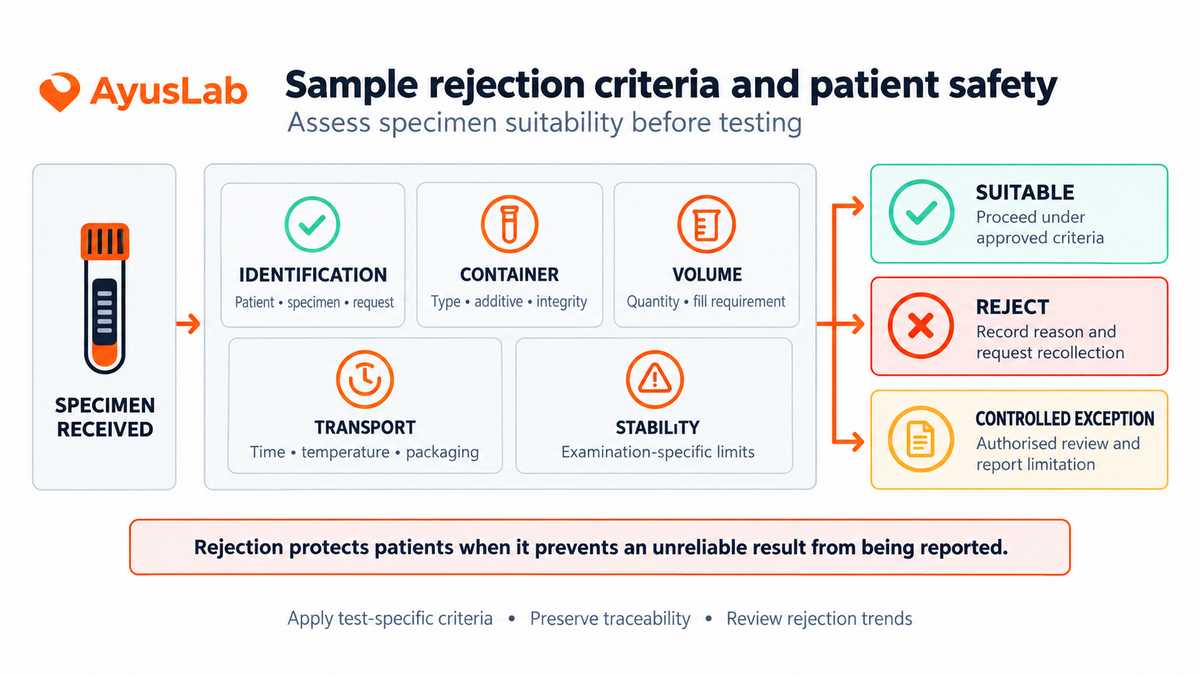
A result is only as reliable as its specimen and supporting information. If identification, container, volume, transport or stability is unsuitable, testing may produce a result that does not accurately represent the patient's condition.
Sample rejection criteria create a controlled decision before testing. They define when a specimen should not proceed, when recollection is required and when an exception needs authorised review. The aim is to avoid unreliable reporting without causing unnecessary recollection and delay.
The practical principle is: apply examination-specific criteria, document the decision, control exceptions and use rejection trends to improve collection.
1. Why specimen suitability matters
The pre-analytical process begins before a specimen reaches the analyser. Preparation, identification, collection, container selection, labelling, handling, transport and storage can affect suitability.
Defects create different risks. Identification errors can break the patient-specimen link. A wrong additive can alter the material. Delay or unsuitable temperature can affect stability. Insufficient volume may alter a required sample-to-additive relationship.
Assess suitability against the requested examinations and approved procedure. Material unacceptable for one examination may remain suitable for another only when that decision is technically justified and traceable.
Recollection can delay diagnosis, require another procedure and sometimes be impossible. The process must balance testing unsuitable material against the consequences of delay or recollection.
2. Common rejection reasons
Frequently encountered categories include:
- missing, incomplete or conflicting patient and specimen identification;
- incorrect container, tube, additive or preservative;
- insufficient quantity or an unsuitable fill volume;
- clotting where an anticoagulated specimen is required;
- visible or measured interference, such as haemolysis, when relevant to the examination;
- leakage, contamination, damage or unsafe packaging;
- collection at an unsuitable time or without required preparation information;
- transport delay or temperature outside defined conditions; and
- specimen age beyond the established stability period.
This is not a universal checklist. Each reason needs an operational definition. Haemolysis may affect examinations differently depending on method and degree. A partially filled tube may be unsuitable where the sample-to-additive ratio is critical without invalidating every requested examination.
Staff should therefore record the specific reason and affected examination, not only a general status such as sample rejected.
3. Test-specific criteria
Acceptance criteria should connect the examination request to the specimen requirements. The controlled procedure should define, where relevant:
- permitted specimen type, collection container and additive;
- minimum volume and any required fill relationship;
- patient preparation or collection timing;
- labelling and traceability requirements;
- storage and transport temperature;
- allowable time between collection, receipt, preparation and examination;
- known interference or integrity conditions; and
- who may assess, reject or authorise an exception.
Criteria may come from the method, manufacturer instructions, validation or verification evidence, stability data, professional guidance and applicable requirements. Generic criteria should not override method-specific limitations.
Collection instructions must be accessible. Criteria known only inside the laboratory cannot prevent unsuitable specimens arriving from wards, clinics, collection centres or referral partners.
4. Authorised exceptions
Some specimens may be clinically critical, difficult to obtain or irreplaceable. An approved exception process must consider the patient's interests without concealing the limitation.
An exception is not the same as declaring the specimen acceptable. It is a documented decision to proceed, limit testing or use another approach after assessing the defect, evidence and consequences of delay.
The procedure should define:
- which situations are eligible for review;
- who is authorised to make the decision;
- whether consultation with the requester is required;
- which examinations may proceed and which remain unsuitable;
- what limitation or caution must appear on the report; and
- what follow-up or alternative specimen is required.
Some problems may leave no defensible path to testing under the laboratory's procedure. The urgency of a request does not establish specimen identity or reverse a material limitation. Professional judgement operates within controlled criteria; it does not replace them.
5. Recollection and communication
When recollection is needed, tell the collector or requester which specimen was rejected, why, which examinations are affected and what is required. Urgent requests need an escalation path.
Avoid messages such as "bad sample." A standard reason with clear guidance helps prevent recurrence. Record who was contacted, when, how and whether the request was acknowledged.
The new specimen should be linked to the original order and rejection event so that delay, repeat collection and final reporting remain traceable. The original record should not be deleted when the replacement arrives.
6. Recording the decision
A useful rejection or exception record connects:
- patient, order and specimen identifiers;
- requested and affected examinations;
- collection and receipt date and time, where relevant;
- specimen condition and standardised reason code;
- person assessing the specimen and decision time;
- rejected, partially accepted or exception status;
- authorisation, consultation and report limitation where applicable;
- recollection request and communication history; and
- replacement specimen and final outcome.
Free text can explain unusual circumstances, but controlled reason codes make trends measurable. The system should preserve both: a consistent category for analysis and enough context to understand the individual decision.
7. Rejection indicators
A rejection rate can help reveal preventable weaknesses, but only when its definition is stable. The numerator might be rejected specimens; the denominator might be all eligible specimens received during the period. Both should specify included locations, specimen types, examinations and exclusions.
Overall rates can hide the cause. Review counts and rates by reason, collection location, specimen type or service area where volumes permit meaningful interpretation. Also watch for changes in recording practice: an apparent increase may reflect better capture rather than worse collection.
A target should not encourage unsafe acceptance or under-recording. Use trends to identify where investigation, education, supply changes or workflow redesign may be needed. Reassess the indicator after action to determine whether recurrence actually reduced.
8. Reducing preventable recurrence
Improvement begins with the dominant verified causes. If identification failures recur, review patient identification and labelling at collection. If wrong containers are common, examine order information, supplies and collector instructions. If transport problems cluster at one location or time, assess packaging, pickup schedules, temperature control and responsibility hand-offs.
Useful actions may include clearer collection guidance, competency assessment, standardised supplies, barcode-supported identification, transport monitoring, feedback to collection sites and focused review of repeated events. The response should address the process that produced the problem, not simply remind staff to "be careful".
Management review should consider rejection trends, exception use, recollection delays, complaints and evidence that corrective actions were effective. Criteria should also be reviewed when methods, equipment, containers, transport arrangements or services change.
ISO 15189:2022 is the current international standard for quality and competence in medical laboratories. NATA's public ISO 15189:2022 assessment worksheet reflects requirements for examination-specific acceptance and rejection criteria, authorised evaluation at receipt, sample traceability and controlled handling of compromised critical or irreplaceable samples. The WHO Laboratory Quality Management System handbook and guidelines on drawing blood provide broader quality and collection foundations. Indian laboratories should verify current applicable NABL documents before publication and implementation.
How a LIMS can support the process
A LIMS can help connect the order, specimen, requested examinations, acceptance decision, rejection reason, recollection and communication record. With verified configuration, it may restrict workflow status, present authorised reason codes, alert responsible users or support rejection-rate analysis.
Software cannot determine whether a compromised specimen is technically suitable, whether an exception is justified or how a limitation affects interpretation. Those decisions remain with authorised laboratory professionals using controlled procedures.
Frequently asked questions
How do sample rejection criteria protect patients?
They prevent specimens with defined identification, integrity or handling problems from proceeding without review, reducing the risk that an unreliable result is reported or attributed to the wrong patient.
Which part of the laboratory workflow is responsible?
Collection personnel, transport teams and accession staff influence specimen quality. Authorised laboratory personnel apply acceptance criteria, manage exceptions and review trends, while management ensures that procedures and responsibilities are defined.
What records should remain available for review?
Retain specimen and order identifiers, affected examinations, condition, reason, decision, assessor, authorisation, communication, exception or report limitation, recollection link and final outcome.
Where can a LIMS help, and where is professional judgement still required?
A LIMS can preserve identifiers, decisions, reasons, workflow status and audit history. Professionals must determine suitability, authorise exceptions, assess limitations and decide the appropriate response.
Reviewing your own lab's processes?
A Lab Growth Session walks through your turnaround time, rejection rates and workflow with our team.
Book a Lab Growth Session