Reducing duplicate patient records in a laboratory
Learn how to reduce duplicate patient records by improving identity capture, patient search, probable-match alerts, controlled merging, and audit trails while preserving complete patient history.
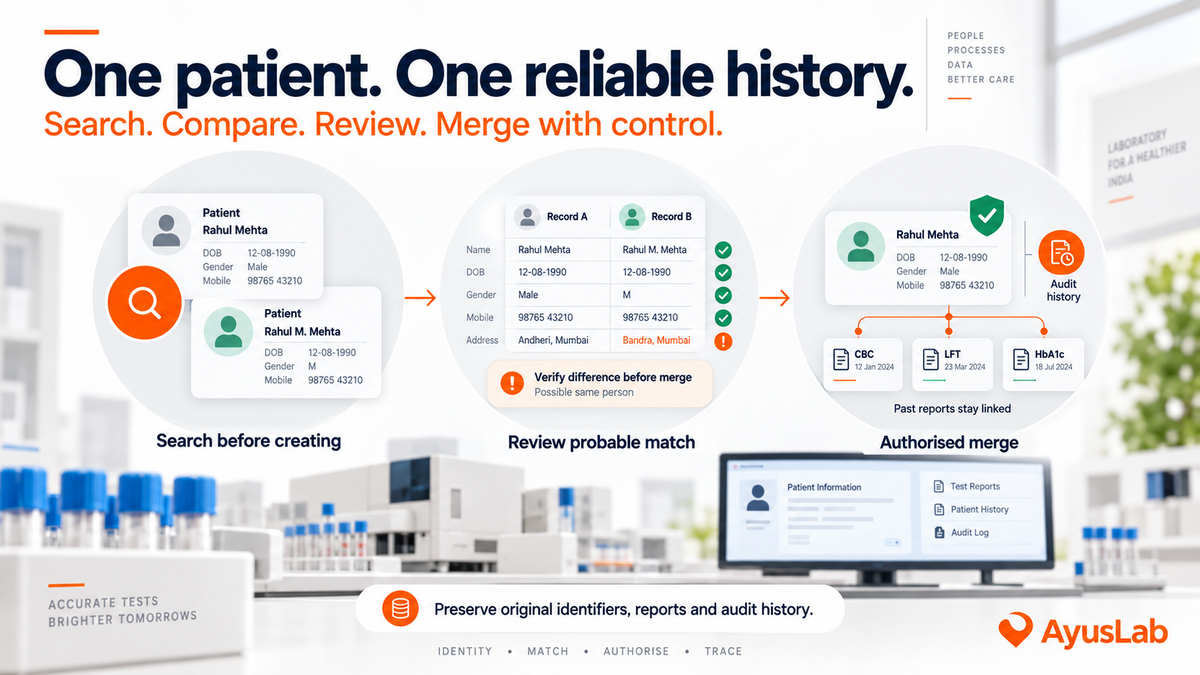
The objective is not simply to find similar names. It is to protect one reliable patient history without joining records that belong to different people.
A duplicate patient record is created when the same person is registered more than once under separate patient identities. The difference may be obvious- a spelling variation or changed telephone number or subtle enough to remain unnoticed until someone tries to review earlier results.
Laboratories cannot solve this by choosing one supposedly perfect identifier. Names may be entered differently, telephone numbers can be shared or changed, addresses become outdated, and dates of birth may be approximate or entered incorrectly. Even a formally assigned identifier can be unavailable at registration or attached to the wrong record.
Reducing duplicates therefore requires a connected process: an identity policy, consistent data capture, effective search, probable-match warnings, controlled merging, preserved history and regular monitoring.
1. Why duplicate patient records matter
Duplicate records fragment the patient's laboratory history. A result may appear under one identity while earlier results remain under another, hiding previous values, trends or corrected reports.
Duplicates also create operational work. Teams spend time searching, confirming demographics, moving reports, responding to patient queries and correcting downstream systems. If two different patients are incorrectly merged, the risk is more serious: information belonging to one person may be displayed or reported under another person's identity.
The control objective has two sides:
- reduce the creation of separate records for the same person; and
- prevent records belonging to different people from being combined.
A high match rate is not evidence of good identity management if the matching process creates false positives. The laboratory needs a workflow that can tolerate uncertainty and route ambiguous cases for authorised review.
2. Understand where duplicates enter the workflow
Common sources include spelling and transliteration differences, initials replacing full names, typing errors, shared or changed telephone numbers, incomplete dates of birth and inconsistent addresses. Workflow design also contributes: duplicates are more likely when staff create a patient before searching, when channels use different identity rules or when another system sends a patient without a reliable link.
Urgency can make the problem worse. If the search is slow, produces too many weak results or interrupts registration without explaining why, staff may bypass it. Duplicate reduction must therefore fit the working pace of the laboratory instead of depending on memory and exceptional effort.
Map how records are created through each channel and review known duplicates. Identify which fields differed, where the second record originated and why the existing record was not selected.
3. Define identity fields and validation rules
The laboratory should define a minimum identity dataset appropriate to its patients, services and jurisdiction. This may include name, date of birth or age, sex, telephone number, address, assigned patient number and an external health identifier. The procedure should distinguish identity from contact fields, identify acceptable unknown values and define how corrections are authorised.
Validation should improve quality without inventing data. Useful controls include valid date formats, plausible age values, telephone formatting and standardised name and address entry. Placeholder numbers or fabricated dates can make unrelated patients appear identical.
The US Office of the National Coordinator for Health Information Technology describes patient matching as linking records using multiple demographic fields such as name, birth date, telephone number and address. Its registration guidance also notes that misspellings, transposed numbers and missing information make matching difficult. The practical implication is clear: no single demographic field should silently determine identity.
Some jurisdictions or accreditation programmes require more than one patient-specific identifier at defined points. The laboratory should verify and implement the requirement that applies to it rather than treating a generic list as a universal rule.
4. Search and probable-match warnings
Search should occur before a new patient record is committed. It should support the ways staff actually look for a person for example by patient number, telephone number, name, date of birth or a combination of fields.
Exact matching alone is insufficient. A patient registered as "Mohammed Rafiq" may later appear as "Mohammad Rafeeq." At the same time, broad fuzzy matching can produce many candidates with common names. The system therefore needs to rank probable matches and show the fields that agree or differ.
A warning should be a review prompt, not an automatic decision. The registration user needs enough context to choose among three outcomes:
- Use the existing patient record when identity is adequately confirmed.
- Create a new record when the person is different or the evidence is insufficient.
- Refer for authorised review when the records may match but cannot be safely resolved at registration.
The laboratory should define what staff may view during this process so that matching does not expose unnecessary patient information.
5. Build the control into registration
The workflow should be short: confirm key identity information, search for an existing patient and review probable matches before creating a record.
When a new record is created despite a strong warning, the system may require a reason such as confirmed different patient, insufficient matching information, urgent registration or existing data requiring review. Reason codes make bypass visible and help identify whether the search logic or training needs improvement.
Edits to identity fields also need control. If a patient's name, birth date, sex, telephone number or identifier changes, the record should preserve the previous value, new value, user, timestamp and reason where appropriate. A correction should not destroy the evidence needed to understand how earlier orders and reports were identified.
Apply the same identity rules across the main laboratory, collection centres, home collection, integrations and patient-facing channels. A strong front-desk process cannot compensate for an interface that creates a patient whenever a minor field differs.
6. Treat merging as a controlled correction
Merging should not be an unrestricted administrative shortcut. It combines longitudinal clinical records and can be difficult to reverse, so the laboratory should define who can request, review and authorise it.
Before merging, the reviewer should compare several identity fields and examine the records for contradictions. Similar names are not enough. Different dates of birth, incompatible contact details or overlapping visits in different locations may indicate that the records belong to different people.
The merge process should identify a surviving record while retaining the retired identifiers as aliases or cross-references. Orders, specimens, reports, invoices and communications should remain linked to their original operational events even when displayed under one consolidated patient history.
If the evidence is uncertain, keeping the records separate and marking them for investigation is safer than forcing a merge. The process should also define whether and how an incorrect merge can be reversed.
7. Preserve report history and the audit trail
A merge must not rewrite the past as though only one identity ever existed. The laboratory should be able to show which records were merged, their original identifiers, who authorised the action, when it occurred and what evidence or reason supported it.
Previously authorised reports should remain available in their authorised form. If a demographic correction requires an amended or corrected report, that action should follow the laboratory's approved reporting procedure rather than silently changing the historical document.
NABL 112A requires medical laboratory information systems to manage workflow, quality and audit trails, maintain confidentiality, use role-based authenticated access and demonstrate an audit trail linking user activity to patient data or software changes. These principles are directly relevant to patient updates and merges, even though each laboratory must define its own authorised process.
8. Monitor duplicate creation and correction
The laboratory cannot improve duplicate control without measuring it. A useful duplicate-rate indicator needs a defined numerator and denominator. For example, the numerator might be patient records confirmed as duplicates during a period, while the denominator might be new patient records created in the same period.
That measure should be interpreted carefully. A temporary rise may reflect better detection rather than poorer registration. The laboratory may also track probable-match warnings, warnings bypassed, merge requests, rejected merges, incorrect merges, reversals and duplicate sources by location or registration channel.
Trend review is more useful than an isolated percentage. Management should ask where duplicates originate, which fields are commonly inconsistent, whether a particular interface or collection centre contributes disproportionately, and whether corrective actions reduce recurrence.
Where a LIMS can help
A LIMS can support duplicate reduction by searching multiple identity fields, presenting probable matches, retaining previous identifiers, limiting merge permissions and recording user actions. Subject to product-owner verification of current behaviour, AyusLab may support parts of this workflow by connecting registration, patient history, orders, reports and audit information.
Software should not automatically declare that two people are the same merely because selected fields match. Nor should it replace an authorised review where evidence is ambiguous. The laboratory remains responsible for its identity policy, access controls, staff training, merge decisions and ongoing monitoring.
The principle is straightforward: search before creating, warn before duplicating, authorise before merging and preserve the complete history afterwards.
Frequently asked questions
What is the simplest definition of reducing duplicate patient records?
It means preventing the same person from being registered under separate identities while also preventing records belonging to different people from being incorrectly combined.
Which part of the laboratory workflow is responsible?
Registration is the main prevention point, but responsibility also includes collection centres, interfaces, patient-facing channels, quality management and authorised personnel who review and merge records.
What records should remain available for review?
The laboratory should retain the original patient identifiers, changed values, probable-match decision, merge request and approval, timestamps, responsible users, reason for action and the history of linked orders and authorised reports, according to its procedure and applicable requirements.
Where can a LIMS help, and where is professional judgement still required?
A LIMS can standardise searches, calculate probable matches, display warnings, restrict merging and preserve audit history. Authorised personnel must still resolve uncertain identity, approve merges, evaluate consequences and decide whether reports require correction or communication.
Reviewing your own lab's processes?
A Lab Growth Session walks through your turnaround time, rejection rates and workflow with our team.
Book a Lab Growth Session