Building end-to-end sample traceability
Understand how end-to-end sample traceability connects patient, order, specimen, barcode, workflow events, results and final disposition. A LIMS can support this process by linking identifiers, timestamps, hand-offs and audit records for better visibility and traceability.
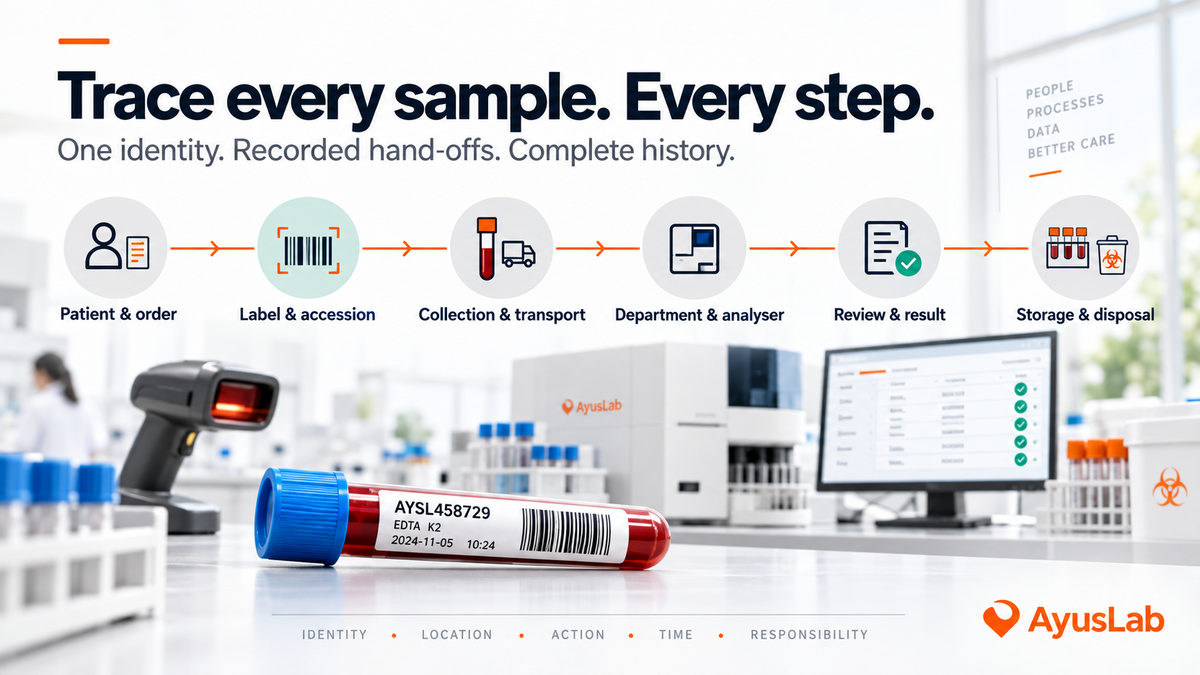
A barcode starts the connection. Recorded hand-offs preserve it.
End-to-end sample traceability means being able to reconstruct the complete journey of a specimen: who it belongs to, why it was collected, which container holds it, where it moved, what happened during analysis, which results came from it and how it was stored or disposed of.
That journey cannot be created by a label alone. A barcode is valuable because it carries a stable identity, but traceability exists only when the laboratory connects that identity to meaningful events and decisions throughout the workflow.
For laboratory owners and operations teams, the practical question is therefore not simply, "Was a barcode printed?" It is, "Can we reliably follow this specimen from the patient and order to the authorised result and explain every important hand-off or exception in between?"
1. Traceability has to cover the complete workflow
A traceable workflow links the patient, order, specimen, container, location, examination process, result and final disposition. The laboratory should be able to move both forwards and backwards through that chain.
Starting with a patient, the team should be able to identify every related order and specimen. Starting with a reported result, it should be possible to identify the source specimen, the analytical event and the people or systems involved in review and authorisation.
This scope should include routine work and less predictable paths such as recollection, referral, aliquoting, reruns, repeat testing, instrument downtime and authorised exceptions. If traceability works only when the specimen follows the ideal route, it is incomplete.
ISO 15189:2022 provides the international framework for quality and competence in medical laboratories. In India, NABL 112A states that its specific criteria are to be used together with ISO 15189:2022 and applicable legal requirements. The practical design of traceability must therefore reflect the laboratory's accredited scope, approved procedures and jurisdiction not a generic software workflow.
2. Begin with patient and order identity
The chain starts before collection. The laboratory needs an unambiguous connection between the patient, the request and the examinations ordered.
Useful controls may include defined patient identifiers, an order or accession number, the requesting source, ordered tests, relevant collection instructions and the intended specimen type. The laboratory's procedure should define how staff resolve incomplete, conflicting or duplicate demographic information.
The objective is not to collect the maximum possible data. It is to capture enough verified information to prevent the order, specimen and result from becoming separated or being associated with the wrong person.
Changes also need control. If a name, demographic detail, test request or referring source is corrected, the system should preserve who changed it, when it changed and why. Silently replacing the original information weakens the audit trail.
3. Accession numbers and labels create the working identity
At accession, the laboratory converts the request into an operational identity that can move through the workflow. A barcode or other machine-readable label reduces reliance on handwriting and repeated data entry, but the label must be generated from the correct order and applied to the correct container at the correct point.
The laboratory should define which identifiers appear in human-readable and machine-readable form, how duplicate labels are controlled and what happens when a label is damaged, missing or unreadable. Reprinting should not create an unrelated identity or hide the earlier event.
One order may produce several containers because different examinations require different specimen types or additives. Each container therefore needs its own identity while remaining connected to the same patient and order. The model should distinguish the order, the specimen and the physical container rather than treating them as interchangeable.
4. Collection and transport require recorded hand-offs
Collection adds important context: collector identity, collection date and time, specimen type, container, collection site when relevant and any deviation that could affect suitability. These fields should be determined by the laboratory's approved procedure and the examination concerned.
NABL 112A requires documented collection and handling instructions and a risk-based approach to transport time and conditions. It also says that a collection-time log should accompany transported samples and places responsibility for accepted sample integrity with the laboratory.
For traceability, a dispatch status by itself is not enough. A useful transport record can connect the specimen to dispatch time, origin, destination, carrier or route, receipt time, receiving person or station, condition on arrival and any recorded exception. Temperature or other environmental information should be recorded where the laboratory has determined it is relevant.
The purpose is not to generate unnecessary scans. Each recorded hand-off should answer an operational question: Where is the specimen, who had responsibility for it, and was it received in an acceptable condition?
5. Department and analyser routing must preserve identity
After receipt, specimens may move to different departments, worklists, analysers or manual benches. Routing should connect the container to the correct examination and make pending, received, in-process and completed states meaningful.
When analysers are interfaced, the sample identifier can connect the requested work to the instrument and map results back to the correct record. The laboratory must still verify the interface and manage rejected messages, duplicate transmissions, manual results and instrument exceptions. NABL 112A specifically calls for verification that analyser-LIS and LIS-HIS interfaces transmit data as intended without misfiling results.
A scan is useful only when it represents a defined event. Scanning the same barcode at several stations without clear status meaning creates activity data, not reliable traceability.
6. Aliquots, reruns and exceptions need explicit relationships
Traceability often breaks when the original container no longer follows a simple path. An aliquot should have its own identifier linked to its parent specimen. If it is sent to another section or referral laboratory, that relationship and hand-off should remain visible.
Reruns and repeat examinations also need distinction. A rerun of the same specimen is not the same event as a new specimen collected later. The record should show which material was used, why the action occurred, what result sequence was produced and which result was ultimately considered during review.
Exceptions should be recorded rather than hidden. Examples include insufficient volume, clotting, haemolysis, damaged labels, delayed transport, instrument failure and acceptance of a compromised or irreplaceable specimen under an authorised process. The laboratory's procedure must define who can make such decisions and what information must remain available.
7. Result authorisation completes the analytical link
A result becomes part of the traceability chain only when it remains connected to the source specimen and examination event. The record should support reconstruction of result entry or transmission, relevant flags, review, amendments and final authorisation.
Authorisation should be distinguishable from instrument completion or report dispatch. Where a result is corrected, the original authorised report, reason for correction, authoriser, timestamps and communication record should remain linked as version history.
This is also where the system must preserve professional judgement. A LIMS can present identifiers, rules, flags and prior events, but it does not decide whether a specimen or result is clinically acceptable unless that decision follows the laboratory's validated process and authorised review.
8. Storage, disposal and audit close the chain
The specimen journey does not end when a report is released. The laboratory may need to record storage location, retention period, retrieval, additional testing, transfer and disposal. Requirements differ by specimen type, discipline and jurisdiction, so retention and disposal rules must come from approved procedures and current requirements.
Management review should examine whether the traceability process works in practice. Useful indicators might include unidentified or mislabelled specimens, specimens without collection times, transport exceptions, samples not received at an expected stage, barcode reprints, manual result entry, interface failures and unresolved location discrepancies. Each indicator needs a defined numerator, denominator, owner and action threshold established by the laboratory.
The strongest test is reconstruction. Select a reported result and ask the team to trace it back through authorisation, analysis, routing, receipt, collection, order and patient identity. Then start with a specimen and trace it forward to storage or disposal. Gaps discovered during that exercise identify where workflow controls or records need improvement.
Where a LIMS can help
A LIMS can support traceability by keeping stable identifiers and linking events that would otherwise sit in separate registers or screens. Subject to product-owner verification of current behaviour, an AyusLab workflow may connect registration, accession, barcode labels, department worklists, analyser exchange, result verification and report dispatch. It may also make status, exceptions, timestamps and user actions easier to retrieve.
The value is not that software guarantees sample integrity or compliance. The value is that the approved process can create usable evidence during routine work. Laboratory leadership still has to define the workflow, validate interfaces, train staff, review exceptions and decide what action is appropriate.
End-to-end sample traceability is therefore built from two things working together: a stable specimen identity and a controlled sequence of recorded hand-offs. The barcode carries the identity. The laboratory process gives that identity meaning.
Frequently asked questions
What is the simplest definition of end-to-end sample traceability?
It is the ability to reconstruct a specimen's complete journey from the patient and order through collection, transport, analysis, result authorisation, storage and disposal using connected identifiers and records.
Which part of the laboratory workflow is responsible?
Responsibility is shared across registration, collection, transport, accession, technical sections, result review and records management. The laboratory director or delegated leadership should ensure that responsibilities and controls are defined in approved procedures.
What records should remain available for review?
The required set depends on the examination and jurisdiction, but commonly includes patient and order identifiers, specimen and container identifiers, collection and receipt details, locations and hand-offs, analytical events, exceptions, result review and authorisation, amendments, storage and disposal records.
Where can a LIMS help, and where is professional judgement still required?
A LIMS can connect identifiers, timestamps, statuses, analyser events, flags and audit history. Laboratory professionals must still establish acceptance criteria, evaluate exceptions, assess result validity, authorise reports and determine corrective action.
Reviewing your own lab's processes?
A Lab Growth Session walks through your turnaround time, rejection rates and workflow with our team.
Book a Lab Growth Session