Managing reruns, repeats, dilutions and reflex testing
Learn how to manage reruns, repeats, dilutions and reflex testing by tracking each analytical event, trigger, result and authorisation while preserving a clear reportable result.
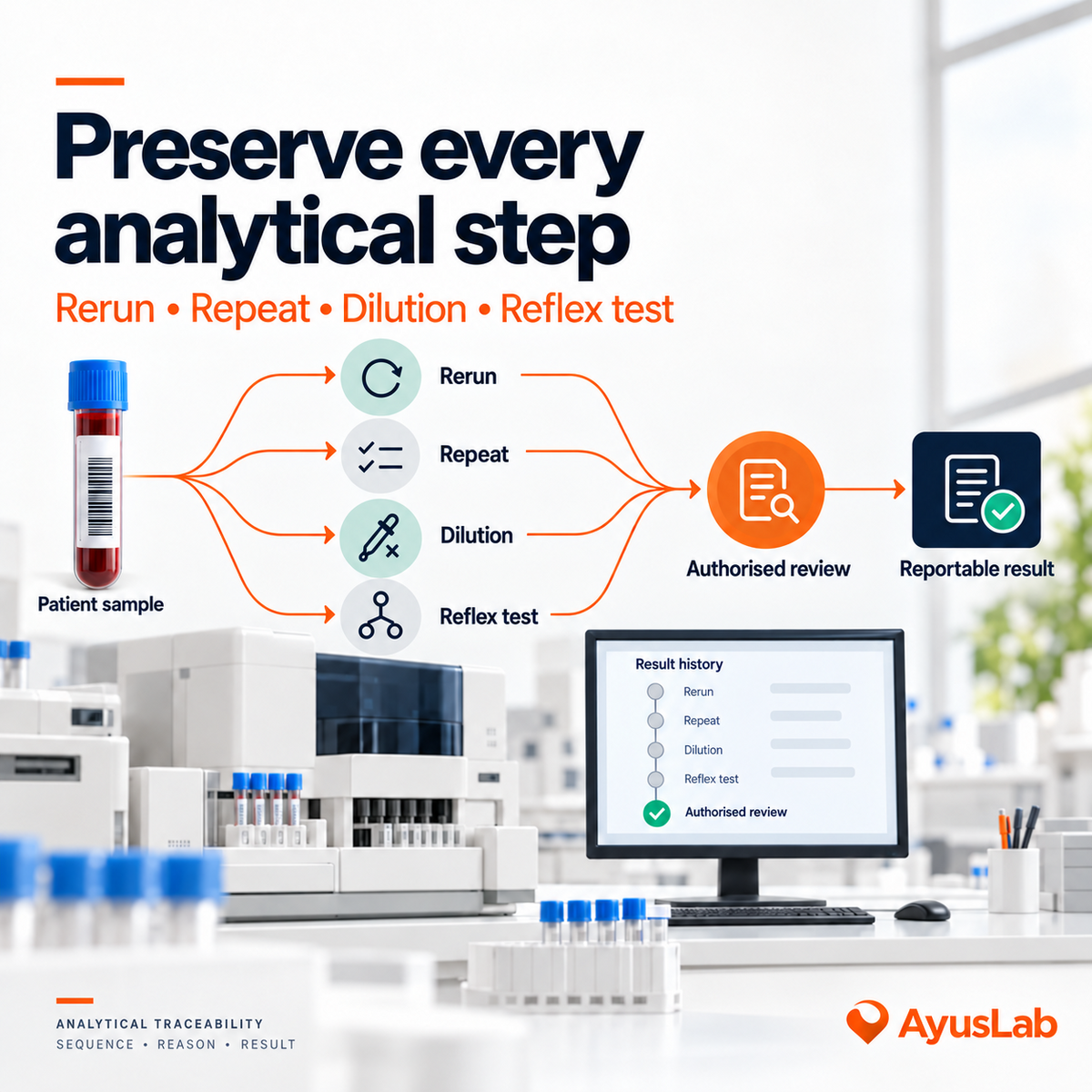
A result may pass through several analytical events before it becomes reportable. An analyser may rerun after a flag, an operator may repeat after checking the specimen, a high concentration may require dilution, or an initial result may trigger a different test. Recording all these events simply as repeat loses the reason, sequence and evidence behind the final result.
The objective is not to repeat every unusual result. It is to define when each action is appropriate, preserve the complete analytical sequence and make the selected reportable result clear. The laboratory's approved procedure, manufacturer instructions, validated measurement range, patient and specimen context, and authorised professional judgement must govern the decision.
ISO 15189:2022 is the current international standard for medical laboratory quality and competence. In India, NABL 112A supplements it, while amended NABL 112B distinguishes protocol-based dilution, problem correction, reanalysis and authorised review. Verify clause references against the licensed standard and current jurisdictional documents before implementation.
1. Define the four events locally
Terminology is not uniform across laboratories or instruments. The approved procedure should define each term and map analyser messages to the laboratory's vocabulary.
| Event | Practical working definition | What must remain traceable |
|---|---|---|
| Rerun | Another measurement of the same test, usually on the same specimen or prepared material and analytical system | Original measurement, analyser flag, rerun trigger and both outputs |
| Repeat | A new analytical attempt performed to confirm or resolve a result under an approved rule | Reason, specimen or aliquot used, method and comparison with earlier results |
| Dilution | Preparation or instrument-managed dilution followed by measurement and calculation of a reportable result | Diluent, factor, preparation mode, measured value and calculated value |
| Reflex test | A different or additional test initiated by a predefined, authorised rule after an earlier finding | Triggering result, rule version, added test, order authority and final reporting relationship |
A recollected specimen is not merely another rerun. It is a new specimen event with its own collection time, identity and pre-examination history. Similarly, reflective testing, in which a qualified professional adds a test after considering broader information, should not be confused with a predefined reflex rule.
2. Preserve order, specimen and event relationships
The order, specimen accession and every analytical event should remain connected. A rerun may use the primary specimen, a new aliquot or the same prepared material. A dilution creates a derived preparation. A reflex test may use the existing specimen if suitable or require a new specimen.
The record should identify:
- the original order and test;
- the patient, specimen, container and accession;
- every aliquot or derived preparation;
- the analyser, method, reagent and relevant run details;
- the relationship between the initial, repeated and additional tests; and
- the result selected for reporting.
For reflex testing, the laboratory must also define whether the original request, service agreement, consent framework and charging policy permit the additional test. These requirements vary by jurisdiction and service model; software should not silently create clinical or financial authority.
3. Control the triggering rules
Triggers may come from an analyser, middleware, LIMS rule or authorised staff member. Examples include an instrument error, result outside the validated measurement range, specimen concern, delta-check prompt or predefined reflex algorithm.
The trigger alone should not automatically determine the response unless the complete rule has been validated and approved. A value above the analytical measurement range may lead to dilution when the method and manufacturer instructions allow it. An error flag may require inspection, corrective action and reanalysis rather than an immediate repeat. Some results should be held for authorised review instead of being repeatedly tested until they appear more familiar.
Each automated rule should state its scope, exclusions, action, stop condition and escalation route. The laboratory should validate the rule with representative cases, control changes through versioning and review its performance after implementation. Universal repeat thresholds should not be copied from another laboratory without evaluating the local method and risk.
4. Make operator actions explicit
Once a trigger occurs, the worklist should tell the operator what requires attention without making the professional decision for them. Useful actions include accept, inspect specimen, rerun, repeat from new aliquot, dilute, request recollection, start approved reflex test, refer for review and document no further action.
The operator should select a controlled reason and add context where necessary. The system should record who initiated and performed the action, the reason, time, instrument and material used.
Permissions matter. Routine analyser-driven reruns may be available to trained technical staff, while certain repeat decisions, reflex additions, overrides or report selections may require an authorised reviewer. The laboratory's competency and authorisation matrix should govern these rights.
5. Keep a complete result version history
The final report should not be created by overwriting earlier values. Every received or manually entered result should remain in sequence with its status: preliminary analytical output, held, invalidated with reason, superseded, selected for reporting or authorised.
Version history should show which result was selected and why. If an earlier result was released, the corrected-report procedure applies; changing the database value is insufficient. The correction reason, authoriser, timestamps and communication record must remain available.
NABL 112A expects laboratory information systems to manage workflow, quality and audit trails and to link user activity with patient data or software changes. That makes traceability more than a technical log: it should reconstruct the decision from the original measurement to the authorised report.
6. Protect flags, units and calculations
Dilution is particularly vulnerable to hidden calculation errors. The record should distinguish the analyser's measured value from the final calculated result and retain the dilution factor. It should also show whether dilution was instrument-managed or manually prepared, together with any permitted correction or rounding rule.
Units must remain consistent. Reference intervals, decision limits, flags and comments should apply to the correct final unit and result type. A qualitative output, inequality or out-of-range result must not be treated as an ordinary number merely to complete a calculation.
Calculated tests may need recalculation when a source result changes. The system should prevent an authorised calculated result from remaining linked to a superseded component value without review. Laboratories should also avoid false precision introduced by multiplying a diluted measurement and displaying more digits than the method supports.
7. Authorise the reportable result
Authorisation should consider the complete sequence rather than only the latest number. The reviewer may need to examine QC status, analyser messages, specimen suitability, previous results, dilution details, agreement between measurements and the reflex rule that added another test.
The report should make the final result unambiguous, while the internal record preserves excluded and superseded values. Critical-result communication remains a separate controlled process; rerunning or diluting should not create an undocumented delay in required notification.
Automated selection or release requires validated rules, defined exceptions and a route to authorised review. NABL 112B's workflow illustrates this principle by checking QC, measurement range, dilution, analyser or specimen problems, critical notification and delta checks before automated reporting.
8. Review quality, not just activity counts
Management review should examine why these events occur and whether the rules remain effective. Useful indicators include rerun or repeat rate by test and analyser, dilution frequency, reflex-test yield, invalidation reasons, unresolved flags, amended reports following repeat activity and turnaround-time effect.
Counts require denominators. A high rerun count may reflect workload, an instrument problem, poorly configured rules or habitual repetition. Repeated testing can introduce selection bias if staff continue until a preferred value appears. Review whether the first result was valid, whether the action changed the reportable conclusion and whether a recurrent cause needs correction.
Investigate unusual trends by method, reagent lot, instrument, section, shift or reason code. The purpose is to improve rules, training, equipment, sample handling and workflow design.
Where a LIMS can support the process
Subject to product-owner verification of current behaviour, AyusLab may support this workflow by linking each rerun, repeat, dilution and reflex test to the original order and specimen; recording triggers and operator actions; preserving result versions; calculating approved dilution factors; and presenting the full sequence for authorisation and audit.
The product owner must verify each field, rule, alert, calculation and screenshot before publication. A LIMS can make the sequence visible and traceable, but it cannot determine universal repeat criteria, validate an analytical method or replace laboratory and medical judgement.
One sequence, one defensible result
The central control is simple: do not let several analytical events collapse into one unexplained result. The laboratory should be able to show what happened, why it happened, which material and method were used, what every result was, and why one result was authorised for reporting.
Frequently asked questions
What is the simplest definition of managing reruns, repeats, dilutions and reflex testing?
It is the controlled recording of each additional analytical event, its trigger, material, result and authorisation so the final reportable result can be reconstructed and justified.
Which part of the laboratory workflow is responsible?
Responsibility is shared across technical staff, section heads and authorised reviewers according to the event. The laboratory's procedure and competency matrix should define who may perform, override and authorise each action.
What records should remain available for review?
Retain the original order and specimen links, all analytical outputs, flags, reason codes, aliquots, dilution details, calculations, reflex-rule version, operator actions, invalidations, selected result, authorisation and relevant communications.
Where can a LIMS help, and where is professional judgement still required?
A LIMS can maintain relationships, apply validated rules, record actions and preserve version history. Laboratory professionals must define the rules, assess specimen and result validity, investigate discordance and select and authorise the reportable result.
AyusLab-branded laboratory workflow showing rerun, repeat, dilution and reflex-test events preserved as separate paths before one result is selected and authorised for reporting.
Reviewing your own lab's processes?
A Lab Growth Session walks through your turnaround time, rejection rates and workflow with our team.
Book a Lab Growth Session