Designing an effective pending work and exception management process
Learn how laboratories can manage pending work and exceptions by tracking workflow stage, reason, age, ownership and escalation to support timely resolution and better operational control.
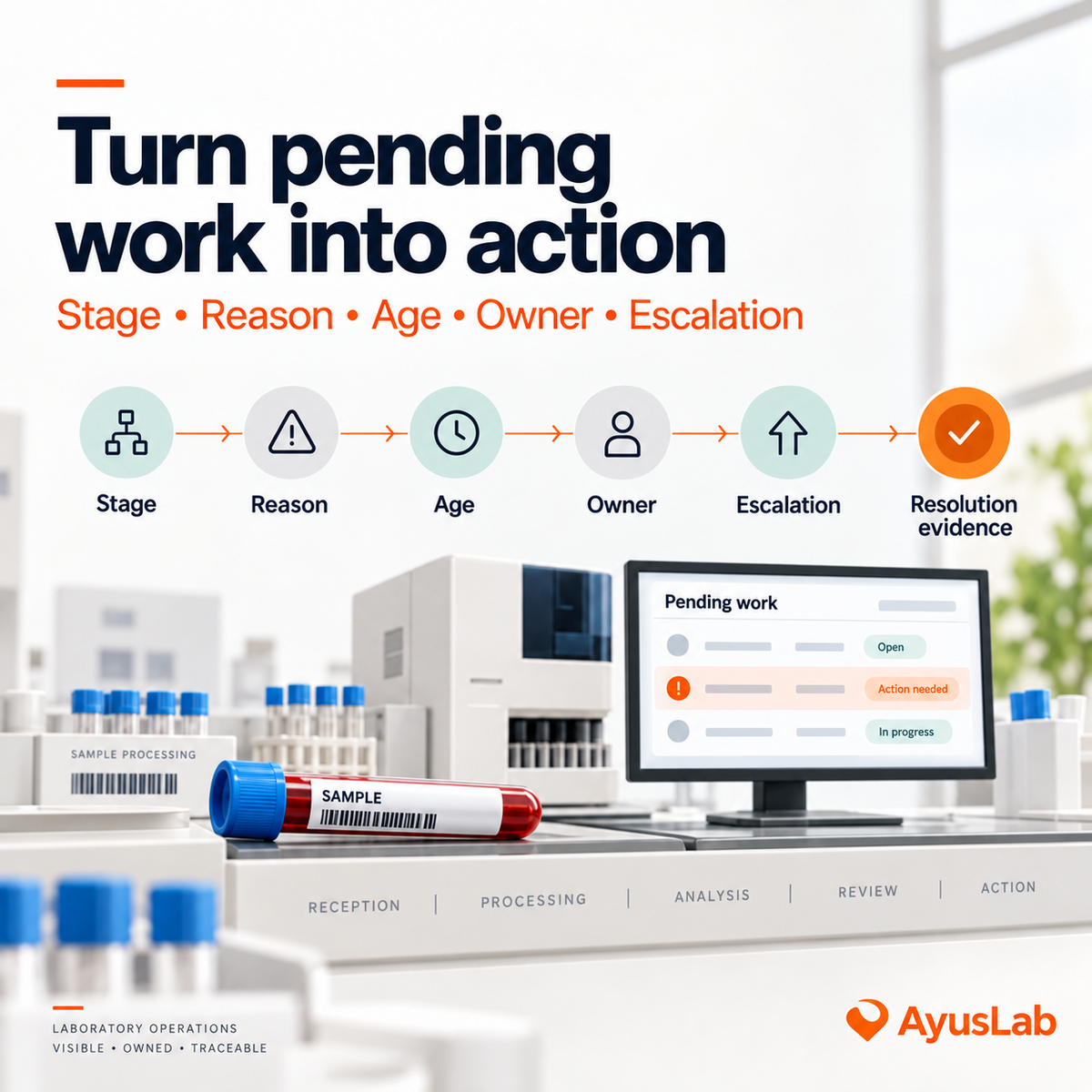
A laboratory worklist can show that 127 items are pending and still leave the team unsure what to do next. The total describes volume, but it does not reveal where work has stopped, why it is waiting, how long it has waited, who owns the next action or when escalation is required.
An effective process turns unfinished work into prioritised action. It connects each item to its stage, reason, age, owner and escalation path while preserving evidence of what was done. The design must reflect the laboratory's test menu, risk assessment, approved procedures and jurisdictional requirements.
This matters within a quality management system. ISO 15189:2022 is the current published international standard for medical laboratory quality and competence. In India, NABL 112A elaborates its application and identifies turnaround time and process downtime among the areas laboratories should monitor through quality indicators. The laboratory should verify all clause references against its licensed standard and the latest applicable accreditation documents before publication or implementation.
1. Pending work and exceptions are not the same
Pending work is incomplete work that may still be following its expected path. A sample awaiting a scheduled analytical run, a completed result awaiting authorised review or a referral test within the agreed reporting interval can all be legitimately pending.
An exception is a condition that prevents normal progress, creates uncertainty about the validity or completeness of the process, or requires a decision outside the usual flow. Examples include an unsuitable specimen, missing request information, failed internal QC, analyser downtime, an interface transmission failure or an overdue result that needs investigation.
A pending item can become an exception when its age, reason or risk crosses a laboratory-defined rule. It may return to the routine path after an authorised action. Keeping workflow stage and exception state as separate fields makes that transition visible.
2. Use statuses that describe the actual stage
A single status called pending conceals too much. The worklist should use a controlled set of stages aligned with the laboratory's workflow map, such as:
- Awaiting collection
- Collected or in transport
- Received and awaiting preparation
- In analysis
- Awaiting review or authorisation
- Authorised and awaiting dispatch
The exception state can show whether the item is progressing normally, on hold, awaiting information, under investigation, escalated or resolved. Every status needs a defined entry event, exit event and responsible role in the approved procedure.
This structure also prevents a common reporting error: treating every incomplete item as a failure. A sample waiting within its expected schedule is operationally different from a sample that cannot proceed because an analyser is unavailable.
3. Measure age from the event that matters
Age becomes useful only when its starting point is defined. The relevant clock may begin at order entry, collection, receipt, accession, arrival in a department, completion of analysis or submission for review. The correct event depends on the question being managed.
For example, the team investigating transport delays needs collection-to-receipt time, while the section head managing authorisation delays needs result-ready-to-authorisation time. One end-to-end elapsed time cannot locate both problems.
Targets should be set by the laboratory for the test, priority category and workflow concerned. Routine and clinically prioritised work may require different monitoring and escalation rules. Referral tests, batch methods and tests dependent on specialist review may also follow different schedules. The worklist should therefore compare each item with the correct laboratory-approved target rather than a universal limit.
4. Record controlled reason categories
Delayed is a description, not a useful reason. Controlled categories make patterns measurable and help route work. Categories may include:
| Reason group | Illustrative examples |
|---|---|
| Patient, request or specimen | Missing information, recollection required, insufficient volume, identification query |
| Analytical system | QC investigation, calibration issue, analyser fault, reagent unavailable |
| Information flow | Interface failure, order mismatch, report transmission problem |
| External dependency | Referral laboratory delay, courier disruption, awaiting authorised clarification |
| Operational capacity | Unplanned absence, specialist review queue, competing urgent workload |
Categories should be few enough to use consistently but specific enough to guide action. A free-text note can preserve context, but should not replace the controlled reason code.
5. Give every actionable item an owner
Ownership answers one question: who is responsible for the next action now? It may be an individual for a specialised decision or a role-based team queue for routine work. It should not default indefinitely to the person who created the order or last touched the record.
Clear ownership requires:
- a named role or team for each stage and reason;
- a visible hand-off when responsibility changes;
- coverage rules for shifts, absence and downtime; and
- a record of assignment, acceptance and reassignment.
Assigning an owner does not make that person the cause of the delay. Managers should examine whether recurring queues arise from unclear design, insufficient capacity, equipment constraints or poor routing before attributing them to individual performance.
6. Escalate according to risk, age and context
Escalation should be defined in the laboratory's procedure, not improvised after an item becomes seriously overdue. A practical rule can combine the item's clinical or operational priority, current stage, exception reason, elapsed time and effect on other samples or results.
The escalation path should specify the first recipient, the next contact if there is no response, the required acknowledgement and the evidence to retain. A higher-risk exception may need immediate review even when it is new; a lower-risk pending item may need attention only as it approaches its target.
Alerts should lead to an action such as accepting ownership, adding information, recording containment or escalating further. Repeated notifications without acknowledgement rules can produce alert fatigue. Escalation supports timely attention, but it does not replace authorised laboratory or medical judgement.
7. Preserve evidence of resolution
Removing an item from the worklist is not enough. The record should show what the exception was, what action was taken, who performed and authorised it, when it occurred and what evidence supported the decision. Where relevant, it should also link affected specimens, tests, reports, equipment events or communications.
Resolution may mean restoring normal processing, recollecting the specimen, rerunning an examination, correcting an interface problem, referring work elsewhere or cancelling under an approved rule. The original reason should remain available after closure. If the issue returns, reopen the record or link it to a new event rather than silently overwriting it.
This is consistent with NABL 112A's expectation that laboratory information systems manage workflow, quality and audit trails, with user activity linked to patient data or software changes. The laboratory must still apply its own record-retention rules and applicable local requirements.
8. Use management patterns to improve the process
Daily teams need item-level action; management needs patterns. Useful views include pending and exception counts by stage, age band, reason, section, test, location and current owner. Counts should be paired with a denominator or workload context where appropriate. Twenty exceptions may reflect a serious deterioration in a low-volume service or normal variation in a much larger workload.
Trend review should ask whether work is entering the queue faster than it is resolved, whether the same reason recurs, whether hand-offs create delay and whether corrective actions have reduced recurrence. The WHO Laboratory Quality Stepwise Implementation tool recommends monitoring critical process indicators, investigating adverse changes and using findings for corrective and preventive action.
Management review should focus on system improvement: workflow design, staffing and competence, equipment reliability, supplier performance, referral arrangements and information-system controls. A dashboard is useful only when it leads to a documented decision and follow-up.
Where a LIMS can help
Subject to product-owner verification of current behaviour, an AyusLab workflow may support visibility by recording stage timestamps, controlled reason codes, current ownership, acknowledgements, escalation activity and resolution history. It may also connect an exception to the relevant patient, order, specimen, analyser event and report, making review evidence easier to retrieve.
The product owner should verify every described field, rule, alert and screenshot before publication. A LIMS can make the process more visible and traceable, but it does not define the laboratory's targets, decide whether a result is valid or replace the laboratory's approved procedure and professional judgement.
From a passive queue to controlled action
An effective pending-work and exception process should answer five questions for every item: Where is it? Why is it waiting? How long has it waited? Who owns the next action? What happens if it remains unresolved? When those answers are connected to documented resolution and management review, the worklist becomes a control mechanism rather than a passive total.
Frequently asked questions
What is the simplest definition of pending-work and exception management?
It is a controlled process for identifying unfinished or abnormal work, prioritising it by stage, reason, age and risk, assigning the next action, escalating when required and documenting resolution.
Which part of the laboratory workflow is responsible?
Responsibility follows the item's current stage. Collection, reception, analytical sections, authorised reviewers, referral coordination and reporting teams may each own an action. The laboratory should define those hand-offs in its workflow map and approved procedure.
What records should remain available for review?
Keep the item identifier, workflow stage, relevant timestamps, exception reason, priority, owner, actions, acknowledgements, escalations, resolution evidence and authorisation. Retention must follow the laboratory's policy and applicable requirements.
Where can a LIMS help, and where is professional judgement still required?
A LIMS can organise queues, record timestamps and reasons, route ownership, issue configured alerts and preserve history. Laboratory professionals must define the rules, assess risk and validity, decide the appropriate action and authorise release or return to routine work.
Reviewing your own lab's processes?
A Lab Growth Session walks through your turnaround time, rejection rates and workflow with our team.
Book a Lab Growth Session