Managing multiple branches and collection centres
Learn how to manage multiple laboratory branches and collection centres with shared governance, connected workflows, controlled local differences, and complete sample traceability across locations.
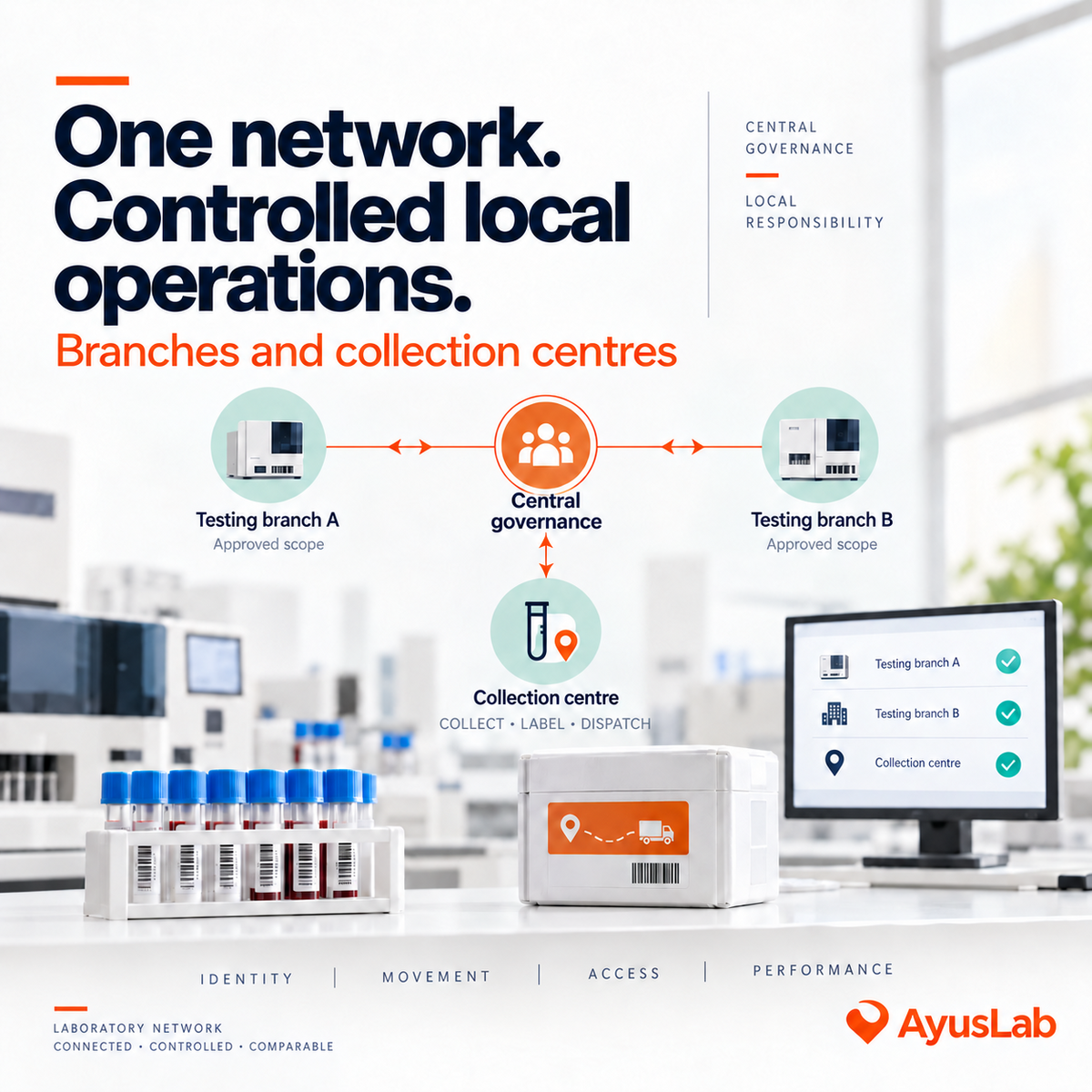
A laboratory network should feel consistent to patients and staff without pretending that every location does the same work. A testing branch may receive specimens, perform examinations and authorise results. A collection centre may register patients, collect specimens and arrange transport to another site. Their activities, staffing, equipment and accreditation status can differ, so the first control is to define each locations role accurately.
Consistency comes from a common operating system: central masters and governance, controlled local differences, connected sample movement and comparable evidence. It does not mean forcing every branch into an identical timetable, price list or test menu. It means that each approved difference has an owner, an effective date and a reason—and that the patient, order and specimen remain traceable throughout the network.
ISO 15189:2022 specifies quality and competence requirements for medical laboratories, while ISO 20658:2023 covers collection and transport processes, including requests, patient identification, collection and transport. In India, NABL guidance also places the operation and quality of declared collection centres within the laboratory's quality system. Laboratories should verify the licensed standards, current NABL documents and applicable state or national requirements before publication or implementation.
1. Start with a network operating model
Create a controlled register of every branch and collection centre. For each location, record its ownership or contractual relationship, permitted activities, hours, responsible person, available tests, referral routes and applicable accreditation or recognition status. This prevents a commercial location list from becoming an inaccurate picture of the laboratory system.
The model should answer practical questions. Which site owns the patient order? Where is the specimen expected to be tested? Who investigates a missed pickup? Which laboratory authorises the result? What happens when the planned analyser is unavailable? Which location appears on the report and invoice?
Define these relationships in the laboratory's workflow map and approved procedures. Review accreditation claims separately for each location; a branch or collection point should not imply a scope it does not hold. NABL's current medical-laboratory guidance says only collection centres declared to NABL may be claimed as part of the recognised system and calls for the centre's name and address to appear on test reports where applicable.
2. Maintain one patient identity policy
Multiple locations increase the chance of duplicate records, demographic inconsistencies and results being attached to the wrong patient. Use an enterprise identity policy that defines required identifiers, acceptable supporting evidence, search steps, probable-match warnings and controlled correction or merge processes.
A single identifier is rarely perfect. Names can be transliterated differently, mobile numbers can be shared and local identifiers can change. Staff should search using an approved combination of fields before creating a new patient. When records are merged, preserve the original identifiers, reports, reason, authoriser and audit history.
Patient access should also be location-aware. A receptionist may need to find a prior patient registered elsewhere, but that does not automatically justify access to every clinical or financial detail. Define what staff can search, view, change and export according to role and legitimate work need.
3. Centralise masters and control local differences
The network needs one governed source for test codes, specimen and container requirements, units, methods, report names, reference intervals, turnaround-time definitions and referral destinations. Without central masters, the same test can acquire different codes or instructions at different sites, breaking comparison and traceability.
Local differences may still be valid. A branch may have a restricted test menu, a region-specific price, a different courier schedule or an approved local referral route. Treat these as configured overrides linked to the central definition - not as independent copies. Each override should have approval, scope, effective date and version history.
Pricing needs the same discipline. Define who may change tariffs, packages, discounts and partner rates; how changes are approved; and which date governs an order. Clinical masters and commercial masters should remain linked but separately authorised so a price edit cannot silently alter the examination definition.
4. Connect collection and transport
The collection centre should create more than a tube and a receipt. The record should connect the patient and order to a labelled container, collection location, collector, date and time, specimen type, requested examinations and destination laboratory.
At hand-off, a manifest or equivalent record should identify what left, who released it, who accepted it, the transport container or route and relevant time or temperature evidence. Receipt at the destination should reconcile what was expected with what arrived. Missing, delayed, damaged, leaking, incorrectly labelled or unsuitable specimens need defined exception paths.
NABL 112B emphasises documented instructions for collection, handling and transport, protection of sample integrity and training of collection-centre staff. The laboratory's own validated conditions and manufacturer instructions remain decisive for specific specimens and tests; the article should not present one transport time or temperature as universal.
5. Make receipt and pending work visible
A central dashboard should not show only a total number of pending samples. It should distinguish work by current stage, location, age, priority, reason and owner. Useful states include collected but awaiting pickup, in transit, expected but not received, received but not accessioned, routed for testing, held for clarification and completed but awaiting authorisation.
This stage detail turns a count into action. A collection-centre lead can investigate an uncollected batch; accession staff can reconcile a manifest discrepancy; a section head can reroute work after analyser downtime. Escalation rules should follow the laboratory’s approved targets and patient context, not a generic timer.
Use stable timestamps and reason codes so the same event is measured consistently across locations. If one branch records received at building entry and another records it after accession, their turnaround-time figures are not comparable.
6. Define roles, access and accountability
Build permissions from both role and location. A phlebotomist, courier coordinator, accession user, bench operator, authorising professional, finance user and network administrator require different actions and views. Cross-location access should be deliberate, not inherited simply because the sites share software.
Keep high-risk actions controlled: editing patient identity, changing master data, overriding acceptance decisions, reprinting labels, authorising results, issuing refunds and merging records. Record the user, time, original value, new value and reason where relevant. Temporary or emergency access should expire and remain reviewable.
NABL 112A calls for role-based authenticated access and an audit trail connecting user activity with patient data or software changes. It also expects laboratory information processes to support workflow, quality and audit trails. These controls support accountability, but they do not replace competency assessment, supervision or professional authorisation.
7. Reconcile settlement and compare performance
Where collection centres, franchises or partners participate financially, settlement should reconcile orders, cancellations, discounts, refunds, payments and agreed shares. Keep the commercial record linked to the patient encounter and service event while protecting clinical information from users who do not need it.
Operational comparison needs defined indicators and denominators. Examples include specimen rejection per specimens received, recollection per collections, transport exceptions per consignments, orders not received within the defined route window, turnaround-time performance by test and priority, complaints per encounters and downtime by location.
Compare like with like. A small collection centre and a high-complexity testing branch have different risk profiles. Trends within a site, followed by peer comparison among similar sites, are more useful than a single league table. NABL 112A identifies collection and identification, transportation and processing, reporting, turnaround time, complaints and downtime among areas suitable for quality indicators.
8. Govern the network as one quality system
Use common controlled procedures for the core process and approved local addenda where conditions genuinely differ. Competency records, document distribution, equipment oversight, incidents, nonconformities, corrective actions and change control should identify the relevant location.
Audit the path across sites, not only each room in isolation. Follow a sample from request and collection through transport, receipt, testing, reporting and record retention. Review whether hand-offs, interfaces and contingency routes preserve identity and evidence. NABL 112B calls for internal audit of each declared collection centre at least annually and for those audits to be discussed in laboratory management review.
Management review should combine local ownership with network learning. A recurring transport delay at one centre may require a route change; similar label failures across sites may indicate a master-data or training problem. Record the decision, owner, due date and effectiveness review.
Where a LIMS can support visibility
Subject to product-owner verification of current behaviour, AyusLab may support this model through central master data, location-specific permissions and configurations, barcode or manifest records, specimen movement timestamps, pending-work views, linked settlement records and comparative operational reporting. Product screenshots should use anonymised examples and accurately reflect the released workflow.
A LIMS can connect evidence and make exceptions visible. It cannot decide the laboratory's network structure, validate local requirements, establish professional competence or authorise departures from procedure. Those responsibilities remain with the laboratory and its authorised personnel.
The practical principle is simple: standardise what must be common, approve what must differ, and keep every hand-off visible.
Frequently asked questions
What is the simplest definition of managing multiple branches and collection centres?
It is the controlled operation of several locations through shared governance, identity rules and master data, with approved local differences and traceable movement of orders, specimens, results and records.
Which part of the laboratory workflow is responsible?
Responsibility is shared across network leadership, quality management and local operational owners. Each stage and exception needs a named owner, while the laboratory retains oversight of the complete quality system.
What records should remain available for review?
Keep current location scopes, agreements, master-data versions, access rights, training and competency records, collection and transport evidence, manifests, receipt exceptions, result authorisation, audit trails, settlements, indicators, audits and management-review actions according to approved retention rules.
Where can a LIMS help and where is professional judgement still required?
A LIMS can link identifiers, apply approved configurations, record movement, restrict access and present exceptions or trends. Laboratory professionals must still define policy, assess specimen suitability, investigate events, interpret evidence and authorise decisions.
Reviewing your own lab's processes?
A Lab Growth Session walks through your turnaround time, rejection rates and workflow with our team.
Book a Lab Growth Session