How diagnostic laboratories build trust and earn repeat visits
Building trust with patients and referring physicians is essential for accelerating diagnostic laboratory growth. By focusing on sample collection, proactive communication, rapid turnaround times, and accuracy, you can elevate your service standards and drive long-term business success.
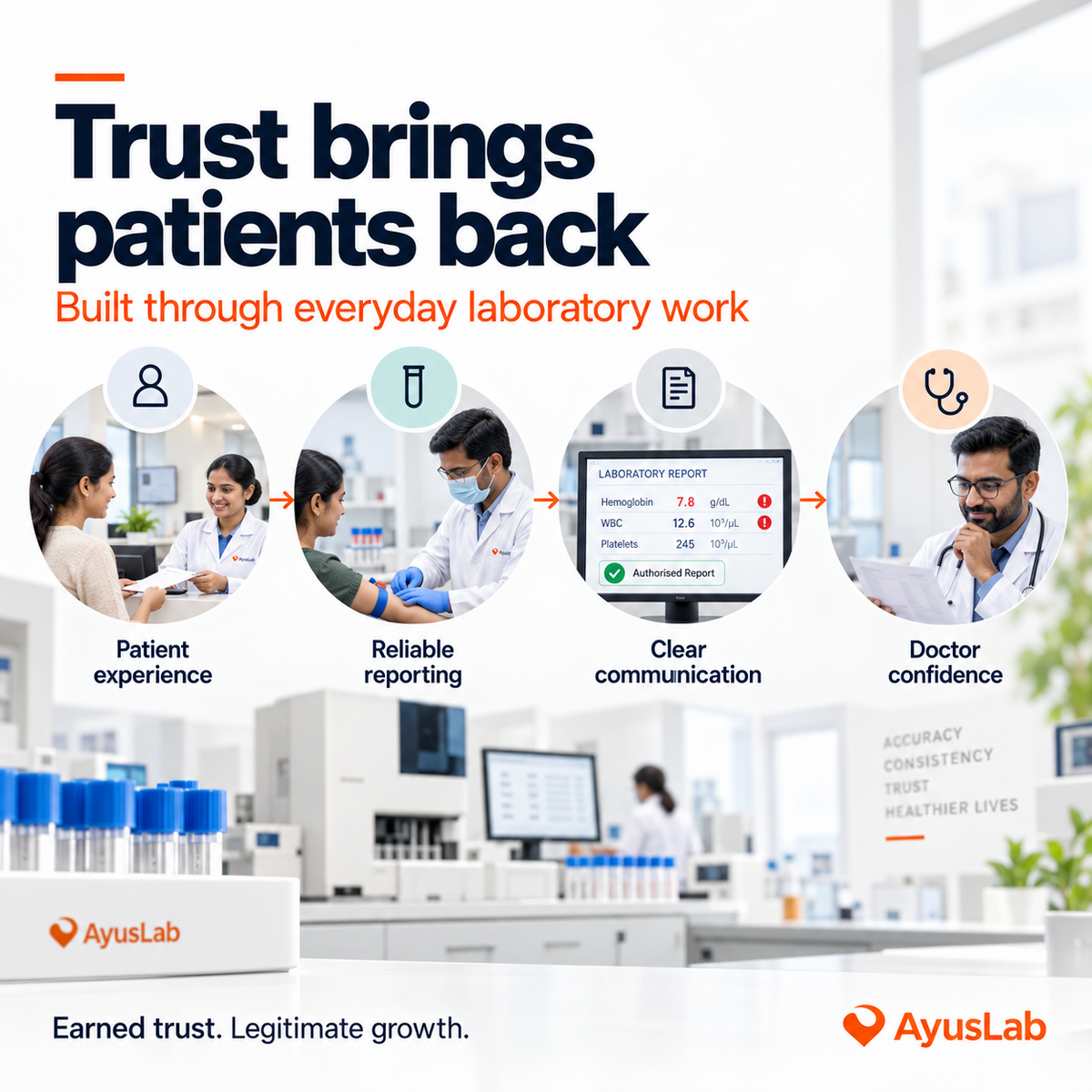
A 50% Diwali offer may attract attention, but it is a weak foundation for sustainable laboratory growth. Healthcare demand is largely need-based. Most people do not want more tests; they want a dependable laboratory when a test is genuinely required.
That changes the question for a laboratory owner. It should not be “How can we persuade patients to test more often?” or “How can we make doctors send more referrals?” It should be:
- Will the patient remember and choose our laboratory when the next legitimate need arises?
- Does the doctor trust our reports enough to continue relying on us?
Footfall is then an outcome of trust—not the direct target. That trust is built through hundreds of ordinary operational details: how a patient is greeted, how smoothly a sample is collected, whether the promised reporting time is reliable, how results are reviewed and how clearly the laboratory communicates.
1. Healthcare growth is different from retail promotion
Discounting can influence where a person tests when a valid need already exists. It cannot create durable loyalty on its own. If the registration is confusing, collection is unpleasant, the report is delayed or the doctor questions its reliability, the discount is quickly forgotten.
Laboratories should also avoid building growth around unnecessary testing. Screening and follow-up programmes may be appropriate when supported by professional guidance and laboratory-approved processes. But encouraging more tests merely to increase revenue risks weakening the very trust on which the business depends.
The stronger growth model is simple: be the laboratory that patients remember, doctors trust and staff can operate consistently.
2. Patient trust and doctor trust are connected
Patients and doctors experience the laboratory differently.
The patient notices convenience, cleanliness, waiting time, staff behaviour, collection quality, communication and whether the report arrives when promised. The doctor notices specimen quality, analytical consistency, appropriate units and reference intervals, report clarity, result history, critical-result communication and the laboratory’s response when clarification is needed.
These are not separate reputations. A patient may prefer a laboratory, but the doctor can lose confidence in its report. A doctor may trust the analytical quality, but the patient may avoid returning because the service was difficult. Sustainable growth requires both experiences to work together.
3. Make the visit easy before the sample is collected
The patient experience begins before arrival. Test preparation instructions should be clear, consistent and specific to the laboratory’s approved procedure. Patients should know whether fasting or timed collection is required, what documents to bring, where to go and when the centre is open.
At registration, staff should confirm identity and order details without making the process feel repetitive or careless. Probable duplicate records, incomplete demographics and unclear doctor or referral details should be resolved through a controlled workflow rather than silently creating another patient record.
For home collection or collection-centre models, the laboratory should also make the location, assigned collector, scheduled window and sample hand-off visible. Convenience builds trust only when traceability remains intact.
4. Treat sample collection as a core service experience
For many patients, the phlebotomist is the laboratory. A technically strong laboratory can still lose trust through poor collection behaviour.
The basics matter:
- greet the patient and confirm identity respectfully;
- explain the immediate collection step in simple language;
- use the correct container and label it at the approved point;
- protect privacy and maintain an orderly collection area;
- record collection time and relevant exceptions; and
- explain what happens next.
The goal is not hospitality theatre. It is a calm, predictable and competent experience. A difficult collection should be handled honestly, with the event documented and the patient informed about the next step when recollection is required.
5. Tell the patient when the report will be ready—and keep the promise
“Report will be ready soon” is not useful communication. The laboratory should define turnaround time by test, priority and workflow—not use one promise for every investigation.
At registration or collection, the patient should receive a realistic expected time or window. If a delay occurs because of recollection, equipment downtime, referral testing, rerun, dilution or professional review, the laboratory should communicate the revised expectation through an approved channel.
The objective is not to promise the fastest report. It is to provide a reliable promise and manage exceptions visibly. A laboratory that consistently meets a realistic commitment often earns more confidence than one that advertises speed but repeatedly misses it.
6. Make report quality visible
The report is the laboratory’s most important product. It should make the authorised result easy to identify while preserving the technical information needed for safe review.
Depending on the test and laboratory procedure, this may include the test and parameter name, result, unit, applicable reference interval, abnormal flag, specimen information, authorisation details and method where relevant. Method visibility can matter when interpretation or comparison depends on it.
Abnormal and critical results must not be treated as the same thing. An abnormal flag follows the laboratory’s approved classification logic. A critical result follows a separate urgent communication process with recipient, acknowledgement, escalation and documentation. A red mark on a report is not proof that the critical communication loop was completed.
Reruns, repeats, dilutions and reflex tests should also remain traceable. The laboratory record should preserve the analytical sequence, reason, timestamps, operator activity and final reportable result selected by the authorised reviewer. The patient or doctor does not need to see every internal event, but the laboratory must be able to explain how the reported result was produced.
ISO 15189:2022 specifies requirements for quality and competence in medical laboratories. Accreditation alone does not create trust, but daily practices that produce competent, traceable work do.
7. Build doctor confidence through consistency and communication
Doctors should not have to decode changing report formats, uncertain flags or unexplained corrections. Consistent test names, units, intervals, comments and report presentation reduce friction.
When a result requires urgent communication, the laboratory should contact the authorised recipient through its approved closed-loop process. When a report is corrected, retain the original version, correction reason, authoriser, timestamps and communication record.
Responsiveness also matters. A doctor query should reach someone capable of explaining the laboratory process or arranging professional review. Trust grows when the laboratory is easy to reach, transparent about limitations and disciplined when something changes.
8. Stay remembered without becoming intrusive
Communication should support the laboratory service, not become constant promotion. Useful messages include collection confirmation, realistic report timing, delay notification, report availability and an appropriate request for feedback.
The laboratory can make its name, contact details and secure report access easy to find so the patient remembers where the service was received. A patient app may provide report history and convenient access, but it should not be used to push unnecessary testing or make diagnostic claims.
The aim is recognition at the next genuine moment of need. That is different from repeatedly reminding a person to buy another test.
9. Measure trust through operational evidence
Trust is intangible, but the processes that create it can be measured. Laboratory owners can review:
- patient waiting time and collection delays;
- sample rejection and recollection rates;
- promised versus actual turnaround time;
- report corrections and their causes;
- critical-result acknowledgement and escalation records;
- complaints and feedback themes;
- repeat patients when a new legitimate order occurs;
- referring-doctor continuity; and
- unresolved queries or communication failures.
No single number proves trust. The value comes from connecting the indicator to a defined process, reviewing trends and acting on recurring causes.
How a LIMS can support the trust-building process
Subject to product-owner verification of current behaviour, AyusLab may help connect patient registration, order and sample identity, collection timestamps, expected turnaround time, analyser and review events, report authorisation, critical-result records, corrections, dispatch history and feedback.
The role of a LIMS is to make the laboratory’s work visible, controlled and traceable. It cannot create trust by itself, guarantee quality or replace laboratory and medical judgement. The system is valuable when it helps staff deliver the laboratory’s approved process consistently.
For a laboratory owner, the principle is straightforward: do not chase footfall directly. Build a laboratory that patients remember for the right reasons and doctors trust because the work is consistently reliable.
Frequently asked questions
Can discounts increase laboratory footfall?
They may influence a patient who already has a valid testing need, but discounts alone rarely create durable trust. Service experience, reporting reliability and doctor confidence are stronger foundations for repeat selection.
What makes a patient return to the same laboratory?
A smooth visit, respectful collection, clear instructions, predictable report timing, easy report access and confidence that the laboratory handled the work carefully can all contribute.
What makes doctors trust a laboratory report?
Consistent analytical quality, clear units and intervals, appropriate method information, controlled abnormal and critical-result handling, traceable authorisation and responsive professional communication.
Where can a LIMS help?
A LIMS can connect identities, samples, timestamps, analyser events, reviews, reports, communication and audit history. The laboratory remains responsible for its procedures, staff competence, decisions and service quality.
Reviewing your own lab's processes?
A Lab Growth Session walks through your turnaround time, rejection rates and workflow with our team.
Book a Lab Growth Session